



Post-War Cars and the Rebirth of the Auto Industry: How the World Learned to Drive Again
Post-War Cars and the Rebirth of the Auto Industry: How the World Learned to Drive Again
After World War II ended, the car industry had a big job ahead. Factories that made war stuff had to start making cars again.
The industry’s output during the war was staggering, playing a critical role in the Allied victory. Switching to making civilian goods was tough. Factories were damaged, materials were scarce, and what people wanted to buy had changed.

But the industry came back strong. New designs, better engineering, and smarter making helped a lot. The rebirth of the auto industry changed how we move, work, and dream.
Key Takeaways
- The automotive industry faced significant challenges after World War II, including destroyed factories and material shortages.
- The industry’s output during the war was critical to the Allied victory.
- The transition from a war economy to a peace economy drove innovations in design, engineering, and manufacturing.
- The post-war period marked a significant turning point for the automotive industry.
- The industry’s rebirth reshaped global mobility, work patterns, and consumer aspirations.
The Devastated Landscape: Auto Industry at War’s End
When World War II ended, the auto industry was in shambles. Factories and supply chains around the world were badly damaged. This made it hard to make cars again.

Bombed Factories and Disrupted Supply Chains
World War II’s end was tough on the auto industry. Many factories were destroyed or used for war efforts. This stopped the making of cars for civilians.
European Manufacturing Centers in Ruins
European cities like Berlin and Paris were hit hard. Their factories were bombed or badly damaged. This hurt the auto industry a lot.
- Germany’s factories were hit hard by bombing.
- France’s car-making places were also destroyed.
American Factories: Converting Back from Military Production
In the U.S., factories made war stuff during the war. Switching back to cars was a big challenge. It needed a lot of work to get things running again.
“The transition from war to peace production was not merely a matter of switching off one assembly line and turning on another. It involved a fundamental transformation of the manufacturing process.” –
The industry had to find new materials and fix supply chains. But, the auto industry was strong. It could change and start making cars again.
From Tanks to Sedans: Reconversion of Wartime Manufacturing
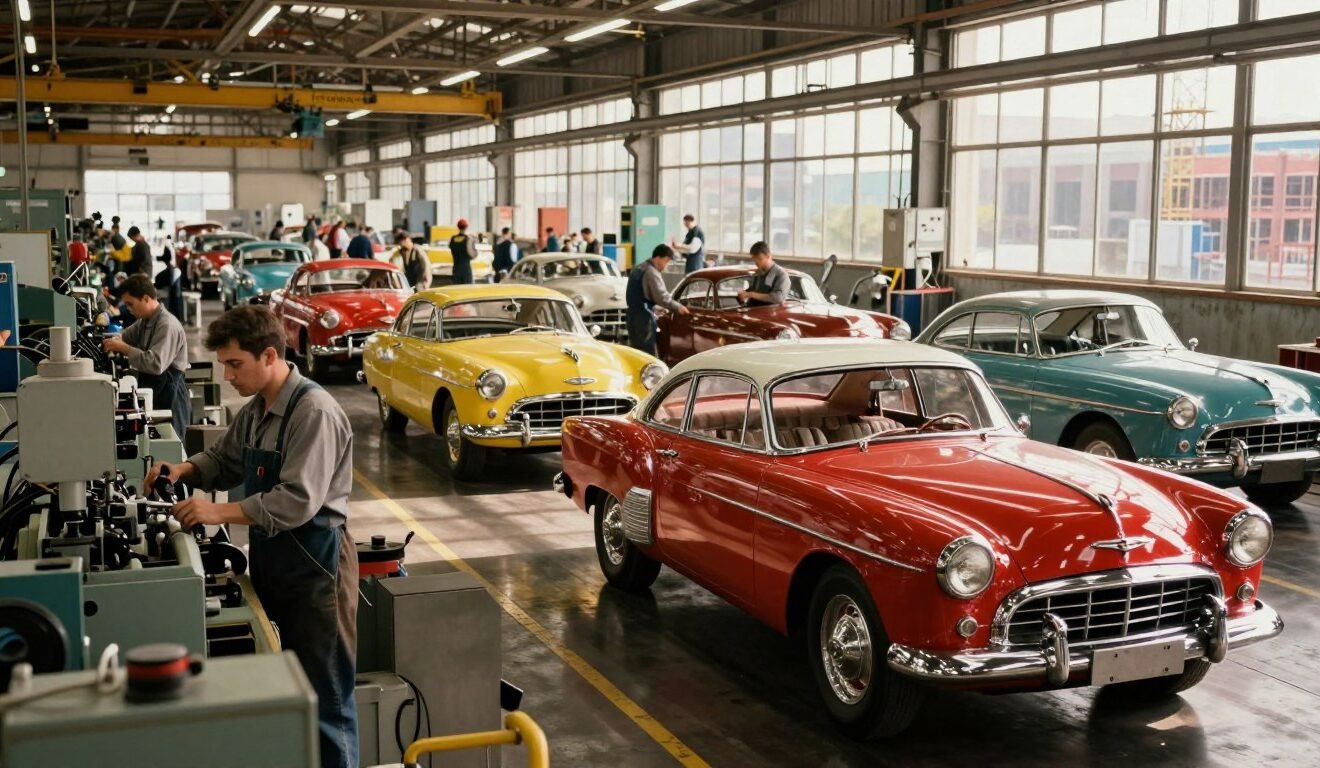
After World War II ended, car makers around the world started a big change. They moved from making tanks to cars. This time, known as the automotive rebuilding era, brought new ideas and tech investments.
Military Production Facilities Transformed
Changing old military plants into car factories was hard. It needed new tools and training for workers. Places like Willow Run, once making bombers, now built cars. This showed the move to making more cars after the war.
Willow Run and Other War Plants
Willow Run, once a bomber factory, showed how cars could be made there. Other old war plants also changed. They used their war skills to help make cars better.
Retooling Timelines and Investment
Changing old factories into car makers needed a lot of money and planning. Car companies had to quickly switch while keeping things complex. This led to big tech improvements. These changes helped shape the car industry for years.
The car industry’s ability to change was amazing. Moving from tanks to cars helped the economy and changed society. It made mass car production a key part of our lives.

Post-War Cars: Design Philosophy and Engineering Evolution
After the war, the car industry changed a lot. It moved from making practical cars to focusing on comfort and style. This change was because people wanted cars that were not just useful but also looked good.
Shifting from Utility to Comfort and Style
In the post-war years, car design evolved a lot. Companies started making cars that were more comfortable, stylish, and innovative. This was because people wanted cars that were luxurious and looked great.
The 1948 Cadillac and Tailfin Era Beginnings
The 1948 Cadillac marked the start of the tailfin era. Tailfins became a symbol of automotive optimism. They showed a futuristic and glamorous design that Americans loved.
Not just the outside, but the inside of cars also got better. Companies added heated seats, better insulation, and ergonomic designs. These changes made driving more comfortable.
| Model | Year | Innovative Features |
|---|---|---|
| Cadillac Series 62 | 1948 | Tailfins, improved interior space |
| Chevrolet Bel Air | 1950 | Enhanced comfort features, stylish exterior |
| Ford Custom | 1949 | Innovative dashboard design, improved engine performance |
The mix of stylish designs, comfort, and new engineering made the post-war car scene special. As people wanted more from their cars, companies got creative. This creativity shaped the car industry’s future.
The Rise of Affordable Mobility: Democratizing Car Ownership
After World War II, cars became more affordable and fuel-efficient. This change made car ownership possible for more people. Automakers shifted their focus to making vehicles that everyone could afford.
Small Cars for the Growing Middle Class
The post-war years saw a big jump in car demand, mainly from the middle class. To meet this need, car makers introduced more affordable models. Small cars became popular, providing a good option for families and individuals.
The Volkswagen Beetle Phenomenon
The Volkswagen Beetle is a symbol of affordable and reliable cars. It played a big role in making car ownership common in Europe and other places. Its simple design, fuel efficiency, and low cost made it a favorite among those on a budget.
British Morris Minor and Austin A40
The British Morris Minor and Austin A40 also played a key role in making cars more affordable. They were made for the average buyer, combining style, reliability, and cost-effectiveness. The Morris Minor was known for its durability, while the Austin A40 was praised for its fuel efficiency and affordability.
These models had a big impact. They:
- Helped more middle-class people own cars
- Boosted the car industry’s growth
- Shaped how people viewed cars in the post-war era
The post-war era was a turning point for the car industry. By making cars more affordable, car makers helped the economy grow. They also changed how people lived, worked, and traveled.
Compact Revolution: European and Japanese Market Responses
European and Japanese car makers led the way in making cars smaller and cheaper. This change made cars more affordable and better for the environment.
European Compact Car Movement
European car makers were known for their smart designs and use of resources. Companies like Fiat, Citroën, and British Motor Corporation made cars that were both affordable and useful.
Fiat 500, Citroën 2CV, and Resource Constraints
The Fiat 500 and Citroën 2CV show how cars were made with less. The Fiat 500 was a hit for its simple yet durable design. The Citroën 2CV was made for farmers in France, with a minimalist approach.
- Fiat 500: Known for its compact size and fuel efficiency
- Citroën 2CV: Featured a minimalist design and robust construction
British Motor Corporation’s Mini
The Mini, launched in 1959, was a game-changer. Its transverse engine and front-wheel drive made it perfect for city living. The Mini’s design is seen in many cars today.
This movement changed the car world in Europe and beyond. Japanese car makers soon joined in, adding to the trend.
The compact car revolution was a key moment in post-war automotive history. It led to more practical and affordable cars. This shift helped the car industry grow globally, leading to the variety of early modern automobiles we have today.
American Auto Giants: Retooling for Peacetime Prosperity
The Big Three American automakers – GM, Ford, and Chrysler – had different plans for the post-war market. As the world moved from war to peace, these giants were key in shaping the future of cars.
The Big Three’s Post-War Strategies
After World War II, the car world in America was all about starting over, being creative, and growing. The Big Three used different ways to meet the demand for cars.
GM’s Multi-Brand Approach
General Motors went for a multi-brand strategy. They had many brands, from affordable Chevrolet to the fancy Cadillac. GM’s plan included:
- Brand diversification
- Innovative design and styling
- Expansion of manufacturing capacity
Ford’s Mass Production Innovations
Ford Motor Company worked hard to improve its mass production. They used their assembly line skills to make cars cheaper and faster. Ford’s big moves were:
- Advanced assembly line techniques
- Standardization of parts
- Introduction of new models like the Ford Custom
These plans helped the Big Three bounce back from the war and become world leaders in cars. The post-war years saw a big post-war manufacturing growth, with American car makers leading the way.
The success of these plans showed in the growth of the American car industry. It became a sign of peacetime prosperity and an example for other fields. As the industry kept changing, the Big Three stayed important, helping automotive export growth and shaping the world car scene.
Global Export Boom: Cars as Economic Ambassadors
The post-war era saw a big boom in car exports. Cars became symbols of economic recovery for the countries that made them. This was due to the need to rebuild after the war and the growing desire for cars around the world.
Expanding International Markets and Trade Networks
After the war, international trade networks grew a lot. The car industry was key in this growth. Countries like the U.S. and those in Europe started sending cars to meet global demand.
American Exports to Rebuilding Europe
American car makers led the export boom. Many of their cars went to Europe to help it rebuild. The Big Three—Ford, General Motors, and Chrysler—were major players in this effort, sending many cars.
| Year | Number of Vehicles Exported | Primary Markets |
|---|---|---|
| 1946 | 120,000 | Europe, Latin America |
| 1950 | 250,000 | Europe, Canada, Australia |
| 1955 | 400,000 | Global, with increased presence in Asia |
European Specialty Cars in American Markets
At the same time, European car makers entered the U.S. market. They brought cars that were more fuel-efficient and innovative. Brands like Volkswagen and Fiat became popular, introducing Americans to new car options.
The sharing of car technology and manufacturing methods between countries helped globalize the auto industry. This marked the start of a new era in international car trade. Cars became symbols of recovery and success.
The Legacy of Post-War Automotive Manufacturing
After World War II, the car industry started to rebuild and innovate. This time was key in making the cars we know today.
Assembly Line Innovations and Global Standards
New assembly line methods improved how cars were made. The Toyota Production System (TPS) was a big step forward. It focused on making cars just in time and always getting better.
Toyota Production System Roots
The TPS was created by Taiichi Ohno and Shigeo Shingo at Toyota. It aimed to cut waste, lower stock, and boost quality. Soon, it became a standard around the world.
“The Toyota Production System is not just a production system; it’s a complete management system that aims to create a culture of continuous improvement.” –
Automation and Efficiency Breakthroughs
Automation was a big help in making cars faster and better. Robots and computers made production quicker and quality higher. These changes helped the car industry grow a lot after the war.
| Innovation | Impact | Year Introduced |
|---|---|---|
| Toyota Production System | Improved efficiency and reduced waste | 1950s |
| Automation in Manufacturing | Increased production speed and quality | 1960s |
| Just-in-Time Production | Reduced inventory and improved supply chain management | 1970s |
After the war, old war tech was used for cars. This helped make cars safer, more efficient, and cheaper.
In summary, the car industry made huge strides after World War II. The Toyota Production System, automation, and just-in-time production changed the game. These changes have shaped the cars we drive today.
Conclusion: How Post-War Cars Shaped Modern Society
The post-war era was a key time for the car industry. It saw big changes in design, engineering, and making cars. As the world moved from war to peace, cars became a sign of modern life and freedom.
The car industry grew strong again after the war. This was thanks to using old war factories to make cars. This made cars cheaper and more for everyone to buy. This helped grow a new culture of buying things.
During this time, famous car brands and models showed the industry’s strength. These cars are now symbols of the industry’s history. They guide how cars are made and designed today.
The impact of post-war cars is seen in today’s car world. It focuses on comfort, style, and new tech. Knowing about post-war cars helps us understand how tech, culture, and society have changed together.