




How Automatic Transmissions Became Mainstream: From Novelty to Driving Standard
How Automatic Transmissions Became Mainstream: From Novelty to Driving Standard
The way we drive has changed a lot over the years. What was once seen as too complex, automatic transmissions have now become a key part of driving.

As cities grew and traffic got worse, people wanted driving to be easier. The drivetrain evolved to help with this, making driving in busy areas simpler.
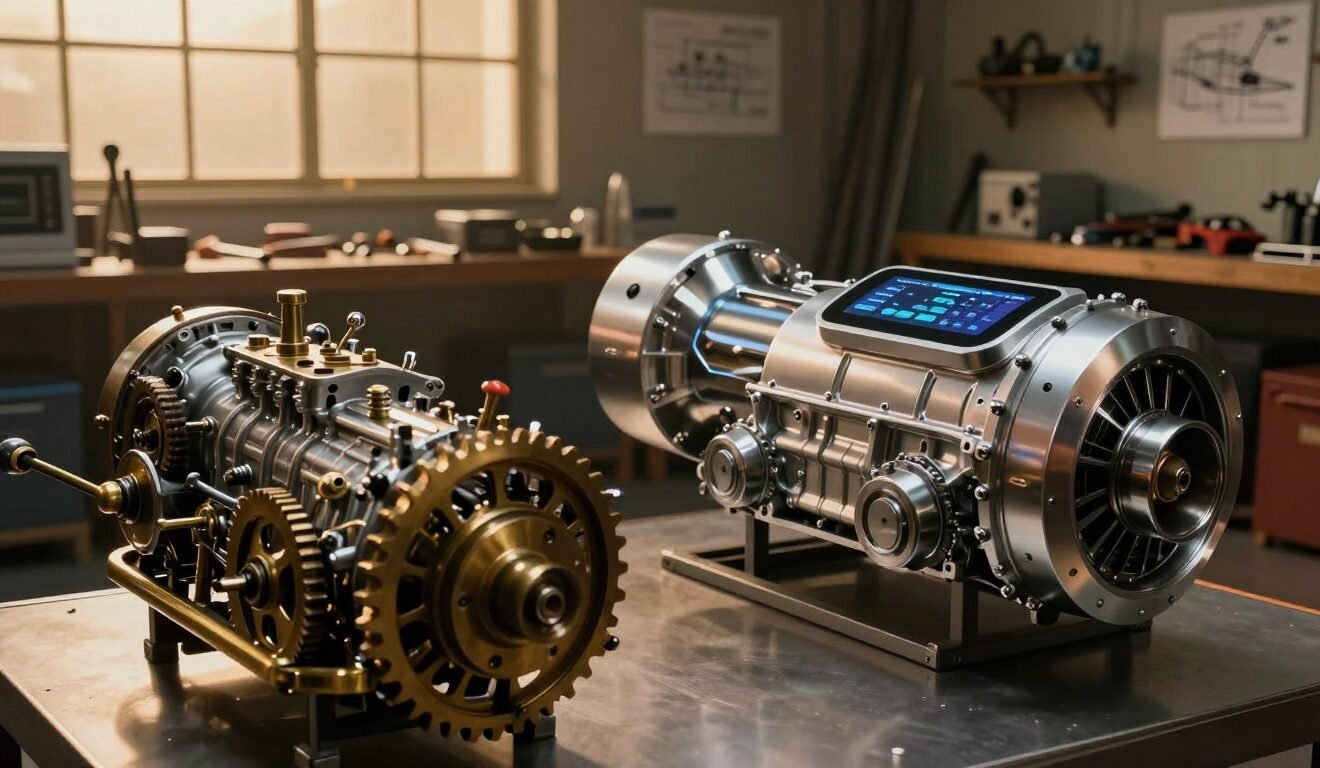
The story of automotive transmission history is one of constant improvement. It started with simple mechanical ideas and has grown into today’s advanced systems.
Key Takeaways
- The rise of automatic transmissions reflects changing driver preferences.
- Drivetrain evolution has been driven by the need for convenience.
- Advancements in technology have improved transmission efficiency.
- The shift towards automatic transmissions has been influenced by urbanization.
- Modern transmissions offer a balance between performance and ease of use.
The Early Days of Transmission Innovation
Early innovations in transmissions paved the way for today’s driving ease. The journey to automatic transmissions started with the need to overcome manual transmission’s limits.
Manual Transmissions and Their Limitations
Manual transmissions were the norm in the early days of cars. Drivers had to shift gears by hand, using a clutch and gearshift. The Henry Ford Museum of American Innovation shows how manual transmissions evolved.
They highlight the mechanical complexity and the skill needed to use them. Shifting gears smoothly was hard, making it tough in heavy traffic.

First Attempts at Automated Shifting (1900-1930)
As cars became more common, inventors started working on automated shifting. They created semi-automatic systems to make driving easier. These early tries, though not perfect, led to better automatic transmissions later on.
The need to improve over manual transmissions and the hope for easier driving pushed innovation forward. This set the stage for the next big step in transmission technology.
Pioneering Semi-Automatic Systems
As cars got smarter, semi-automatic transmissions came first. They were key in making automatics better.
The 1904 Sturtevant Automatic Transmission
The Sturtevant Automatic Transmission was introduced in 1904. It was one of the first semi-automatic systems. It changed gears automatically with clutches and bands. But, it was too complex and had reliability problems.
General Motors’ Hydra-Matic Development
General Motors made big steps with the Hydra-Matic transmission. It was developed in the 1930s. It used a fluid coupling and planetary gears for smooth shifting.
According to General Motors’ Heritage Archive, the Hydra-Matic was a big leap. It made driving better and more reliable.
“The Hydra-Matic transmission was a major breakthrough in automotive technology, making driving more convenient and efficient.”
European Experiments with Self-Shifting Gears
European car makers also worked on semi-automatic systems. Some cars had pre-selector gearboxes. These let drivers choose gears but shift automatically.
These early tests helped create better automatic transmissions later on.
| Transmission System | Year Introduced | Key Features |
|---|---|---|
| Sturtevant Automatic | 1904 | Clutches and bands for automatic gear change |
| Hydra-Matic | 1930s | Fluid coupling and planetary gears |
| Pre-selector gearbox | 1920s | Manual gear selection with automatic shifting |
The early semi-automatic systems were vital for modern automatics. They improved reliability, efficiency, and performance. This led to automatics becoming common in cars.
The Birth of Modern Automatic Transmissions History
The Oldsmobile Hydra-Matic’s debut in 1940 was a big deal. It changed how cars shifted gears. This led to more cars using automatic transmissions.
The 1940 Oldsmobile Hydra-Matic Revolution
The Hydra-Matic was the first automatic transmission made in big numbers. It made driving easier and more convenient. Soon, many wanted it in their Oldsmobiles.
Wartime Applications Accelerating Development
World War II sped up automatic transmission development. They were used in military vehicles. This helped make them better and more reliable.
The EPA says more cars started using automatics during the war.
Technical Principles Behind Early Automatic Systems
Early automatics, like the Hydra-Matic, used hydraulic and mechanical parts. They had fluid couplings and planetary gearsets for smooth shifting. Here’s what these parts did:
| Component | Function |
|---|---|
| Fluid Coupling | Transfers power between the engine and transmission |
| Planetary Gearset | Provides multiple gear ratios for efficient power transmission |
| Hydraulic Control System | Regulates gear shifting based on speed and load |
The Hydra-Matic was a key part in making modern automatics. Its impact is seen in today’s transmissions.
Post-War Expansion and Technical Refinement
After World War II, the car industry saw a big leap in new ideas, like automatic transmissions. People wanted cars that were easier to drive. Chrysler and Ford led the way with better automatic systems.
Chrysler’s PowerFlite and TorqueFlite Innovations
Chrysler brought out the PowerFlite in 1954. It was a two-speed automatic that made shifting easier. Then, in 1956, they introduced the TorqueFlite, a three-speed that was better for performance and gas use. These moves made Chrysler a top name in automatics.
Ford’s Ford-O-Matic and Cruise-O-Matic Systems
Ford started its own automatic line with the Ford-O-Matic in 1958. Later, they came out with the Cruise-O-Matic. This one gave drivers more control and better performance. Ford’s systems were known for being reliable and smooth.
Torque Converter Advancements and Efficiency Gains
The torque converter was a big step forward in automatics. It made them more efficient and better performing. Here are some key improvements:
| Manufacturer | Transmission Model | Year Introduced | Key Features |
|---|---|---|---|
| Chrysler | PowerFlite | 1954 | Two-speed automatic, simplified shifting |
| Chrysler | TorqueFlite | 1956 | Three-speed, improved performance and fuel efficiency |
| Ford | Ford-O-Matic | 1958 | Relying on a torque converter for smooth operation |
| Ford | Cruise-O-Matic | Later Models | More control options for drivers, enhanced performance |
The years after World War II were key for modern automatics. Chrysler and Ford’s new ideas, along with better torque converters, made automatics popular. This set the stage for the future of car technology.
The 1950s-1960s: The Convenience Revolution
After World War II, American car makers started a big change. They worked on making driving easier with automatic transmissions. This time saw a big move towards simpler, more accessible driving.
Marketing Automatic Transmissions to American Families
Car companies ran big ads to show how automatic transmissions were good for families. They talked about how easy and safe they were. They also pointed out how great they were for women drivers, who were becoming more common.
Women Drivers and the Democratization of Driving
More women started driving as automatic transmissions became popular. These transmissions made driving easier, even for those who found manual shifts hard. This made driving more open to everyone, not just men.
Suburban Expansion and Changing Commuting Patterns
As suburbs grew, people had to drive longer to get places. Automatic transmissions were perfect for this, making driving less tiring and more comfortable. They fit well with the changing American lifestyle and driving habits of the 1950s and 1960s.
These factors—ads, more women driving, and new driving habits—came together. They made automatic transmissions a key part of American car culture. This was a big step in the drive for easier driving.
Technical Advancements That Drove Mass Adoption
As technology improved, automatic transmissions became more reliable and efficient. They also became better at performance. This change was key in making them popular across the car industry.
Overcoming Early Reliability and Durability Challenges
Early automatic transmissions had big problems with reliability and durability. They often wore out fast and needed a lot of repairs. To fix these issues, car makers put a lot of effort into research and development.
They worked on making parts last longer and improving how the transmission worked. For example, new materials made gears and bearings stronger. Also, electronic controls helped with shifting and managing torque.
Some major improvements were:
- Stronger clutch packs and bands for longer life
- Advanced computer controls for better shifting
- Improved lubrication systems to cut down on wear
Addressing Fuel Efficiency Concerns
At first, automatics were seen as less fuel-efficient than manuals. But, new tech made them much closer in fuel use. Lock-up torque converters, for instance, cut down on slippage and energy loss.
Also, better transmission control units (TCUs) helped manage fuel better. They chose the right gear and shifted at the best time.
Performance Improvements That Won Over Enthuasiasts
Improvements in performance were key in winning over fans of manual transmissions. Today’s automatics can shift fast and often beat manuals in races. Features like manual mode and paddle shifters make them more fun to drive.
The EPA Automotive Trends Report shows big gains in efficiency and performance of automatics. This has made them appealing to many drivers.
By tackling early problems and innovating, the car industry made automatics a common feature in today’s cars.
Cultural Shifts and Evolving Driver Expectations
Driver expectations changed as cities grew. People wanted a more convenient way to drive. This need grew with urban traffic.
Urban Traffic Growth and the Stop-and-Go Driving Reality
More cars in cities made driving stop-and-go. This was hard on drivers, making them tired and stressed.
Automatic transmissions solved this problem. They made driving smoother, letting drivers relax.
The American Embrace of Automotive Convenience
Americans loved automotive convenience. They wanted to drive easily through busy streets. Automatics made this possible.
How Automatic Transmissions Reshaped Driver Training
The Henry Ford Museum of American Innovation found a big change. Automatics made learning to drive easier. Drivers could learn about safety and navigation instead.
This change made automatics more popular. They became easier for more people to use.
Automaker Strategies and Marketing Transformation
The car industry saw a big jump in automatic transmissions. This led to marketing campaigns to change how people see driving. It moved from seeing automatics as a luxury to a common part of cars.
The Transition from Premium Option to Standard Feature
At first, automatics were seen as a luxury, costing extra. But as they became cheaper and more people wanted them, car makers started making them standard. General Motors’ Heritage Archive shows this change was because of what people wanted and needed.
Key statistics from the transition period include:
| Year | Percentage of Vehicles with Automatic Transmissions |
|---|---|
| 1950 | 15% |
| 1960 | 40% |
| 1970 | 75% |
Advertising Campaigns That Redefined “Normal” Driving
Car makers ran ads to show how easy automatics were to use. They targeted women and families in the suburbs. A
“The introduction of automatic transmissions revolutionized the driving experience, making it more accessible and enjoyable for a wider audience.”
Price Point Strategies That Enabled Mass Market Penetration
To get more people to buy automatics, car makers made them cheaper. This made them more affordable, boosting sales and market share.
These strategies worked well. Over time, automatics became a common feature in cars. Car makers kept improving their marketing, changing how people view automatics.
How Automatic Transmissions Reshaped Driving Accessibility
Automatic transmissions changed how we drive and who can drive. They made driving easier and more accessible to many. This is because you don’t need to shift gears manually.
Expanding Driving Demographics Beyond Traditional Barriers
Automatic transmissions let more people drive, like older adults and those who can’t handle manual shifts. The EPA says this made driving easier for people of all ages.
Accommodating Drivers with Physical Limitations
These transmissions also helped drivers with physical challenges. They could drive on their own, which was a big help for those with disabilities.
Impact on Commercial and Fleet Vehicle Operations
Automatic transmissions made driving easier for commercial and fleet vehicles. They cut down on driver tiredness on long trips and in busy traffic. This made driving safer and more efficient.
In summary, automatic transmissions greatly improved driving for more people. This change had big effects on both drivers and the car industry.
Global Adoption and the Establishment of New Standards
The car industry changed a lot, and automatic transmissions became very popular. They changed how people drive all over the world. Many things influenced how automatics spread, like what people like, new tech, and what buyers want.
American vs. European Acceptance Patterns
In the U.S., automatics quickly became the top choice for many drivers. They were seen as convenient in busy city traffic. But in Europe, drivers liked manual transmissions more. They liked the control and how they saved fuel.
But as cities got busier, more Europeans started to like automatics. This change happened slowly, but it did.
Japanese Innovations and Global Market Influence
Japanese car makers were key in making automatics popular worldwide. They brought new tech that made automatics shift smoother and use less fuel. This made automatics more attractive to more people.
So, Japanese tech really changed the car market. It helped automatics become the standard everywhere.
How Automatics Became the International Benchmark
Automatics became the new standard in the car world. As more car makers used automatics, they became the top choice for many. Today, automatics are common in many places, showing they’re the favorite for millions.
This success also pushed for more improvements. Car makers keep working to make automatics better, aiming for better fuel use, smoother shifts, and a better driving experience.
Conclusion: The Enduring Legacy of Automatic Transmission Dominance
The rise of automatic transmissions has changed the car world a lot. They started as a new idea and now they’re everywhere. This has made driving easier and more fun for many people around the globe.
The EPA Automotive Trends Report shows how automatics are shaping cars today. Their lasting popularity shows the car industry’s ability to keep up with new needs and tech.
Automatic transmissions have changed how we drive and how cars are made. Knowing their history helps us see what the future of cars might hold.
The story of automatic transmissions is one of creativity, change, and lasting success. It shows how tech, what people want, and rules all work together in the car world.