




Karl Benz and the Birth of the Automobile: The Man Who Invented the Modern Car
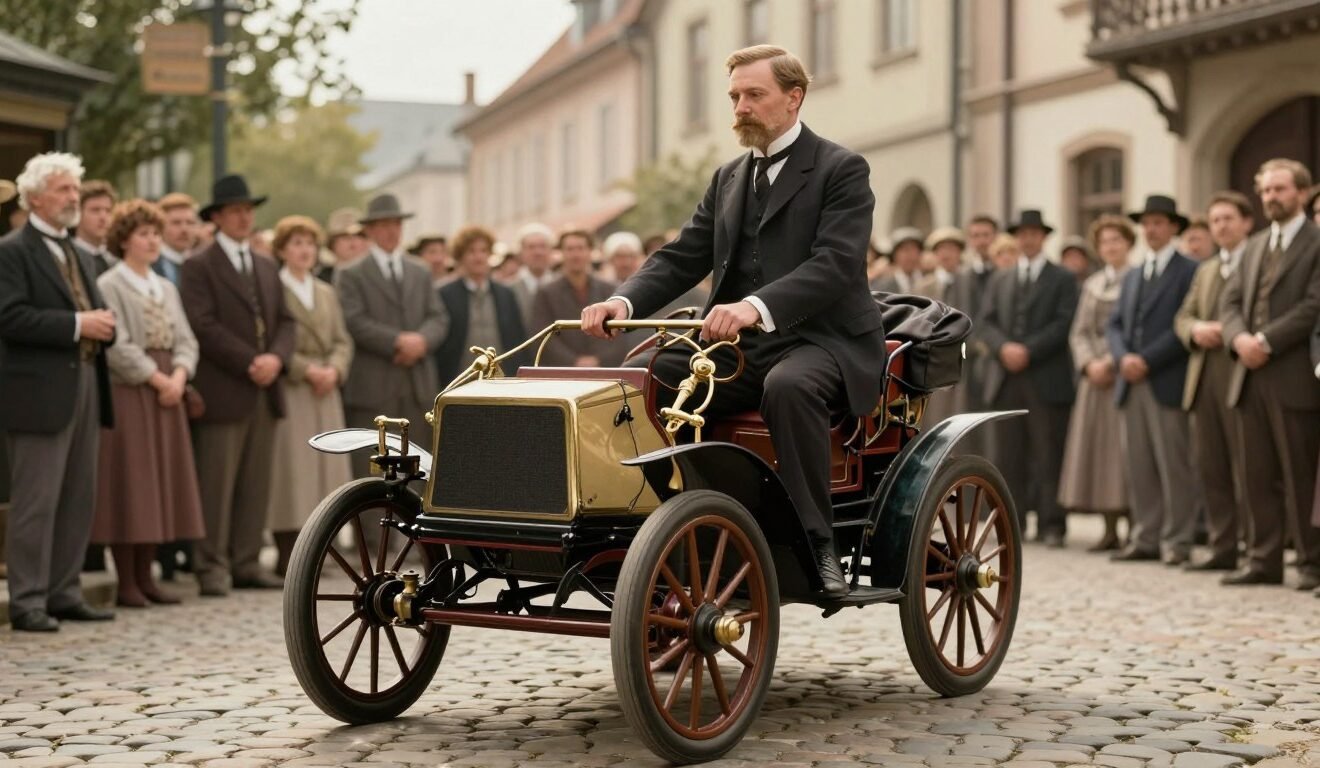
Karl Benz and the Birth of the Automobile: The Man Who Invented the Modern Car
In the late 19th century, a quiet German engineer changed the world. The invention of the first practical gasoline-powered automobile by Karl Benz started a global change. This change reshaped cities, industries, and personal freedom.

Benz’s creation, the Benz Patent-Motorwagen, is seen as the first true automobile. This vehicle set the stage for the modern car industry. It made Benz known as “the father of the car.”
His work changed how people moved around. It changed how we live, work, and travel. This article will look at Benz’s early life, his invention, and its lasting impact.
Key Takeaways
- The Benz Patent-Motorwagen is considered the first practical automobile.
- Karl Benz’s invention revolutionized personal transportation.
- The modern automotive industry owes its foundation to Benz’s innovative work.
- Benz’s creation had a profound impact on cities, industries, and personal freedom.
- The legacy of Karl Benz continues to influence the automotive industry today.
The Early Life of Karl Benz
Karl Benz was born on November 25, 1844, in Mühlburg, Baden. His early years set the stage for his future achievements. His upbringing and education played a big role in shaping him.
Childhood and Education in Germany
Karl Benz grew up in a culturally rich Germany. He studied at the University of Karlsruhe. This university gave him a strong base in mechanical engineering.
The academic program and technology exposure at the university were key. They helped shape his inventive spirit.
The table below summarizes key aspects of Karl Benz’s early education:
| Institution | Field of Study | Years Attended |
|---|---|---|
| University of Karlsruhe | Mechanical Engineering | 1860-1864 |
Early Career as a Mechanical Engineer
After finishing school, Karl Benz started his career as a mechanical engineer. He worked in several engineering firms. This experience helped him design the Benz Patent-Motorwagen.
His early career faced many challenges. But these experiences sharpened his engineering skills.
“The love of practical work, the joy of creation, was the foundation on which my later success was built.”
Karl Benz’s early career was key to his success in automotive engineering. His experiences helped him create the first practical automobile.

The Vision Behind the Karl Benz Automobile
Karl Benz had a clear vision for a future without horse-drawn transportation. He worked hard to create a motorized vehicle. Even with a career in stationary engine design, his focus never wavered.
The Dream of Horseless Transportation
Benz dreamed of a car without horses, a dream many had before him. But he wanted something more. He aimed to make a vehicle that was not only self-propelled but also practical and reliable.
He knew a good engine was key. It had to power the vehicle well.
The benefits of horseless transportation were many:
- Increased mobility and freedom
- Reduced dependence on animal power
- Potential for faster travel times
Conceptualizing a Self-Propelled Vehicle
Creating a self-propelled vehicle was a big challenge for Benz. His experience with stationary engines helped a lot. He used the four-stroke cycle to make a compact, efficient engine for vehicles.

The Benz Patent-Motorwagen was a big step in car history. It had a single cylinder, four-stroke gasoline engine. It could go about 10 mph. This invention started a new era in transportation, leading to more advanced cars later.
Engineering Challenges and Breakthroughs
Karl Benz faced many obstacles in his quest to create the first car. The late 19th century was a time of great technological progress. Yet, it was also filled with big technical hurdles, mainly in car engineering.
Technical Obstacles of the 19th Century
Building the Benz Patent-Motorwagen was tough due to several technical problems. One big challenge was making a reliable petrol two-stroke engine. It had to be efficient, light, and strong enough to move the car.
Benz also had trouble finding a good transmission system. It had to handle the engine’s power and make the car accelerate smoothly.
Early automotive engineering was all about trying new things and finding solutions. Benz was inspired by the mechanical advancements of his time. This included new materials and engineering ideas.

Innovative Solutions and Persistence
Benz’s determination and creativity helped him beat the technical hurdles. He created a four-stroke internal combustion engine, a major breakthrough in automotive engineering history. This engine was more efficient and reliable, a big step forward in mechanical innovation transport.
Benz also improved the transmission system. He added a manual transmission with multiple gears. This made it easier to control the car’s speed and power, improving its performance.
Benz’s innovative engine and transmission improvements were a huge step in early car technology. His work set the stage for the modern car industry. It opened the door for future advancements in car engineering.
The Internal Combustion Engine Revolution
Karl Benz’s work on the internal combustion engine changed the car world. His engine was key in making the first practical car. Benz solved big technical problems, changing the car world forever.
Previous Engine Technologies and Their Limitations
Before Benz, many engine types existed but had big problems. Early steam engines were big and didn’t use fuel well. Other early cars didn’t have enough power or last long.
Some big issues with old engines were:
- They didn’t use fuel well
- They didn’t have enough power
- They were too big and heavy for cars
Benz’s Four-Stroke Engine Innovations
Benz made a big step with his four-stroke engine. His design was more efficient and powerful. The four-stroke cycle – intake, compression, power, and exhaust – became the standard for car engines.
Benz’s four-stroke engine had big improvements:
- It used fuel better
- It had more power for cars
- It was smaller, fitting in cars

Benz’s work on the internal combustion engine was key to the first practical car. His innovations fixed old engine problems, starting the modern car industry.
The Benz Patent-Motorwagen: The World’s First Automobile
The Benz Patent-Motorwagen is seen as the first practical car ever made. It was patented on January 29, 1886. This marked the start of a new era in travel. Karl Benz’s design used an internal combustion engine, a first in vehicle technology.
Design and Technical Specifications
The Benz Patent-Motorwagen had three wheels and an open top. It had a single-cylinder, four-stroke gasoline engine that made 0.75 horsepower. It could go about 10 mph (16 km/h), a slow but important speed for its time.
Here are some key specs of the Benz Patent-Motorwagen:
- A single-cylinder, four-stroke engine
- A manual transmission system with no reverse gear
- A braking system that used both manual and automatic parts
- A wooden frame with steel reinforcement

The Historic First Test Drive in 1885
In 1885, Karl Benz took the Benz Patent-Motorwagen for its first drive. He did it early in the morning to avoid disturbing people. This test was key to checking the car’s performance and finding ways to improve it.
Patent DRP-37435: Securing the Invention
On January 29, 1886, Karl Benz got Patent DRP-37435 for his “Vehicle powered by a gas engine.” This patent made Benz the official creator of the first practical car. It also helped establish Benz as a leader in the car industry.
The importance of Patent DRP-37435 is huge:
- It recognized Benz as the inventor of the first practical car.
- It protected Benz’s rights to his invention.
- It encouraged more innovation in cars.
Financial Struggles and Business Perseverance
Karl Benz had a groundbreaking invention but faced big financial hurdles. He struggled to get the money needed to make his dream come true. The early days of his business were tough, testing his will and determination.
Early Business Ventures and Setbacks
Benz’s first try at making cars was met with doubt. People didn’t think his horseless carriage was practical. But Benz didn’t give up. He kept improving his design and looking for new chances.
His early businesses hit many roadblocks, like technical problems and lack of support. Benz’s hard work and creativity helped him get past these hurdles.
Securing Funding and Establishing Benz & Cie
After years of hard work, Benz got the money to start Benz & Cie. This was a big step for the car industry. He showed his invention’s value and won over investors.
- Securing initial funding to launch production
- Overcoming technical and logistical challenges
- Building a team of skilled engineers and workers
Benz & Cie was a major milestone in car history. Benz’s never-give-up attitude helped start the modern car industry.
Benz’s impact goes beyond his inventions. His business skills and ability to face challenges are inspiring. His story shows how vision and hard work can overcome any obstacle.
Bertha Benz: The Woman Behind the Man
Bertha was more than just Karl Benz’s wife. She was a key player in the Benz Patent-Motorwagen’s success. Her efforts were vital to its triumph.
Her Role as Investor and Supporter
Bertha Benz was Karl’s business partner and investor. She supported his work with both money and encouragement. Her belief in the Benz Patent-Motorwagen was essential when it was new and untested.
“My wife Bertha was the only person who believed in me and my invention when others did not.” – Karl Benz
The First Long-Distance Automobile Journey
In 1888, Bertha Benz took the Benz Patent-Motorwagen on a 65-mile journey. This was the first long-distance drive in an automobile. She proved the car’s durability and practicality.
Marketing Impact of Bertha’s Historic Drive
Bertha’s journey was a huge success. It showed the world that cars were not just toys but real transportation. The media coverage made people interested in the Benz Patent-Motorwagen, boosting sales.
| Year | Event | Impact |
|---|---|---|
| 1888 | Bertha Benz’s long-distance drive | Demonstrated the practicality of the automobile |
| 1888 | Media coverage of the journey | Generated publicity and increased interest in the Benz Patent-Motorwagen |
| 1889+ | Increased sales of the Benz Patent-Motorwagen | Established the foundation for the modern automotive industry |
Bertha Benz’s role in the Benz Patent-Motorwagen’s success was huge. She supported Karl financially and emotionally. She also showed the world what the car could do. Her efforts helped make cars a common sight, making her a true pioneer.
From Invention to Global Industry
Karl Benz’s design of the Benz Patent-Motorwagen started the modern car industry. It changed how people travel and helped create a global industry. This industry has changed economies and cultures all over the world.
Early Production and Commercial Development
The Benz Patent-Motorwagen was the first car you could buy. It was the start of the car industry. Benz & Cie, Karl Benz’s company, became a big success. They made cars that people first doubted but soon loved.
As making cars got better and cheaper, more people could buy them. This helped the car industry grow a lot.
Public Reception and Market Growth
People had mixed feelings about cars at first. Some liked the new idea, while others worried about safety and usefulness. But Bertha Benz’s long drive in 1888 showed cars could be useful. This made more people interested and helped the market grow.
As more people bought cars, car makers started to make their cars better. This led to quick changes in car technology.
The Formation of Mercedes-Benz
In 1926, Benz & Cie and Daimler-Motoren-Gesellschaft merged to form Mercedes-Benz. This company became known for making top-quality cars. The merger was a big step for the car industry, combining two leading companies into one.
Mercedes-Benz started a new time in the car world. It was a time of more competition, new ideas, and a focus on doing things right.
Conclusion: The Enduring Legacy of Karl Benz
Karl Benz is a pioneer in the automotive world. His invention, the Benz Patent-Motorwagen, is a key moment in transportation history. His legacy continues to influence how cars evolve today.
Benz was a key figure in the automotive world. His innovative spirit and hard work led to modern personal transport. His work on the internal combustion engine and the first practical car has had a lasting impact.
Benz’s invention started a new era in transportation. It changed how people live, work, and travel. Today, the car industry keeps growing, thanks to Benz and other early innovators.
Benz’s achievement is important today. His legacy goes beyond cars, showing a big change in society. As the industry grows, Benz’s work shows the power of innovation and creativity.