



The First Self-Propelled Vehicles in Human History: From Steam Dreams to Mechanical Reality
The First Self-Propelled Vehicles in Human History: From Steam Dreams to Mechanical Reality
Humans have always wanted to move on their own. This dream started long ago, with early ideas and tests leading to today’s cars. Ancient people started the journey, but steam power in the 1600s made the dream of moving by oneself real.

The journey to today’s cars took a long time. More than 100,000 ideas were patented to make the modern car. These early tests were key to creating the cars we use now.
Key Takeaways
- The concept of self-propelled movement dates back to ancient times.
- Steam power in the 17th century marked the beginning of self-propelled vehicles.
- Over 100,000 patented ideas have contributed to the modern automobile.
- Early experiments were crucial in shaping modern transportation.
- The history of transportation is a story of continuous innovation.
The Quest for Self-Propelled Movement in Ancient Times
Humans have always been drawn to the idea of moving things on their own. This dream led to many creative ideas and tests across the world.
Early Conceptual Designs from Ancient Civilizations
Cultures like Egypt, Greece, and China looked into making machines that could move by themselves. Their early work set the stage for later advances in engineering.
Egyptian and Greek Mechanical Innovations
In Egypt and Greece, engineers built automated machines, like automatons. These were the first steps towards more complex machines. They showed a basic understanding of how things work.
Chinese Early Self-Moving Devices
In China, inventors made early self-moving gadgets, like complex clockwork machines. These showed a deep understanding of engineering.
Mythological and Theoretical Self-Moving Devices
Ancient societies also dreamed up mythical and theoretical self-moving machines. These ideas, though not always real, helped lay the groundwork for real self-propelled vehicles.
Hero of Alexandria’s Steam-Powered Aeolipile
Hero of Alexandria created the aeolipile, a steam engine. It’s mentioned in his Pneumatica. It was one of the first tries to use steam power.
Ancient Texts Describing Self-Moving Chariots
Old texts tell stories of self-moving chariots, often linked to magic or gods. Though myths, they show how much people wanted vehicles that could move by themselves.
| Civilization | Innovation | Significance |
|---|---|---|
| Egypt | Automatons | Early mechanical devices |
| Greece | Aeolipile | Primitive steam engine |
| China | Clockwork mechanisms | Sophisticated mechanical engineering |

“The aeolipile is a testament to the ingenuity of ancient engineers, showcasing their understanding of steam power and its potential applications.”
Mechanical Principles Behind Self-Propulsion
The early self-propelled vehicles used new ways to make and move power. These ideas were key to making self-moving things real.
Understanding Power Generation and Transfer
At first, power came from steam engines. How well these engines worked depended on turning energy into movement.
Basic Mechanics of Converting Energy to Motion
Turning energy into motion was complex. Early engineers had to find ways to move power from the engine to the wheels.
Early Gearing and Transmission Systems
Gearing and transmission systems were important. They helped change speed and torque, helping vehicles move over different terrains.

Early Engineering Challenges and Solutions
Early engineers faced many problems, like material limits and steering issues. They found new materials and designs to solve these problems.
Material Limitations and Innovations
New materials and ways to make things were key. Advances in metallurgy helped make parts stronger and more reliable.
Steering and Control Mechanisms
Good steering and control were essential. Early solutions were simple but later got better.
Breaking Free from Animal Power: The Revolutionary Concept
The Industrial Revolution marked a turning point. It showed the need to move beyond animal power. As industries grew and trade expanded, the old ways were no longer enough.
Limitations of Animal-Powered Transportation
Animal transport had big drawbacks. Speed, endurance, and cost were major issues.
Speed and Endurance Constraints
Animals could only go so fast and for so long. This made long trips and quick delivery hard.
Economic and Practical Challenges
Keeping animals cost a lot. You also needed places for them to live and eat. Managing many animals was hard too.
The Socioeconomic Drive for Mechanical Alternatives
The need for something better drove the search for mechanical transport. The Industrial Revolution and military needs pushed this forward.
Industrial Revolution’s Demand for Efficient Transport
The Industrial Revolution needed fast ways to move goods and people. Mechanical vehicles promised to be faster and more reliable.
Military Applications and Motivations
Military groups also saw the benefits of mechanical transport. They wanted better mobility and logistics. This pushed the development of early mechanical vehicles even faster.
| Transportation Method | Speed | Endurance | Economic Viability |
|---|---|---|---|
| Animal-Powered | Limited | Restricted by need for rest | High maintenance costs |
| Mechanical Vehicles | Faster | Can operate for longer periods | Potential for lower long-term costs |

Ferdinand Verbiest and the First Self-Propelled Vehicles
Ferdinand Verbiest created the first self-propelled vehicle in 1672. He made a steam-powered scale model car for the Chinese Imperial Court. This was the start of a new era in transportation.

The 1672 Chinese Imperial Court Invention
Verbiest’s invention was a big step forward for its time. It showed his knowledge of steam power and mechanical engineering.
Historical Context of Verbiest’s Work
Verbiest worked during the Kangxi Emperor’s reign. This was a time when China was open to new ideas and technology.
“The Jesuits brought with them not only their religious beliefs but also their scientific knowledge, which significantly impacted Chinese culture.”
Purpose and Reception of the Steam Toy
The steam model was a toy for the emperor. It showed the power of Western science and technology. The court loved it, praising Verbiest’s creativity.
Technical Analysis of Verbiest’s Design
Verbiest’s vehicle was amazing for its time. It used steam from a boiler to move.
Steam Generation and Propulsion Mechanism
The system used a simple boiler to heat water. This made steam that turned the vehicle’s wheels.
| Component | Function |
|---|---|
| Boiler | Generated steam by heating water |
| Steam Engine | Converted steam energy into mechanical energy |
| Wheels | Transmitted the mechanical energy to propel the vehicle |
Limitations and Historical Significance
Verbiest’s invention had its limits, like size and practical use. Yet, it was a key step towards self-propelled vehicles. It showed steam power could work for moving things.
In conclusion, Ferdinand Verbiest’s 1672 invention was a major breakthrough. It opened the door to future advancements in transportation.
European Steam Pioneers of the Early 18th Century
The early 18th century was a key time for steam technology in Europe. It was when important figures made big steps in steam engine technology.
Thomas Newcomen and Early Steam Engine Applications
Thomas Newcomen was an English ironmonger and Baptist minister. He created the first practical steam engine in 1712. It was mainly used for pumping water out of mines.
Newcomen’s engine was a big leap forward. It was more efficient and reliable than earlier models.
From Mining Pumps to Motion Concepts
Newcomen’s first use was for mine water pumping. This was a big change from manual or animal-powered systems. His success opened doors for other uses, like motion.
Newcomen’s Influence on Transportation Thinking
Newcomen’s engine wasn’t used for transport directly. But his work helped others think about steam power for moving things. This was a big step toward self-propelled vehicles.
James Watt’s Innovations and Their Impact
James Watt, a Scottish engineer, made big changes to the steam engine in the late 18th century. His most important work was the separate condenser. It made steam engines much more efficient.
The Separate Condenser Revolution
Watt’s separate condenser cut down fuel use and boosted steam engine power. This was a major leap. It made steam power a real option for many uses, including transport.
Watt’s Reluctance Toward Mobile Steam Power
Watt was hesitant to use his steam engine for mobile power. He focused on making stationary engines better. It was others who used his ideas for moving vehicles.
Looking back, these pioneers set the stage for steam-powered transport. As European steam pioneers kept innovating, we got closer to self-moving vehicles.
“The work of Newcomen and Watt was key for the steam transport revolution of the 19th century,” say historians.

Nicolas-Joseph Cugnot’s Steam Wagon of 1769
Nicolas-Joseph Cugnot’s invention of the fardier à vapeur in 1769 was a big step in the history of cars. This steam wagon was a big engineering achievement. It also helped start the journey to modern cars.
The Fardier à Vapeur: Design and Function
The fardier à vapeur was made to carry heavy loads, like artillery, without animals. Its design showed what was possible and what was not back then.
Military Purpose and Specifications
The fardier à vapeur was for the military. It was meant to help move heavy cannons without horses. It had:
- A steam engine to power it.
- A three-wheeled design, with two wheels at the back and one at the front.
- A top speed of about 2.5 miles per hour.
Operational Mechanics and Performance
The fardier à vapeur used steam to move. Its performance was limited by the technology of the time. But it showed steam could be used for moving things.
The First Automobile Accident in History
Unfortunately, Cugnot’s invention had its problems. The fardier à vapeur was in the first recorded car accident.
Circumstances of the Crash
The accident happened during a test drive. The vehicle couldn’t stop in time and crashed into a wall. This showed the need for better brakes in early cars.
Historical Significance and Aftermath
The accident was a setback, but it didn’t stop people from working on self-propelled vehicles. It helped inventors learn and improve their designs and safety.
The Steam-Powered Transportation Revolution
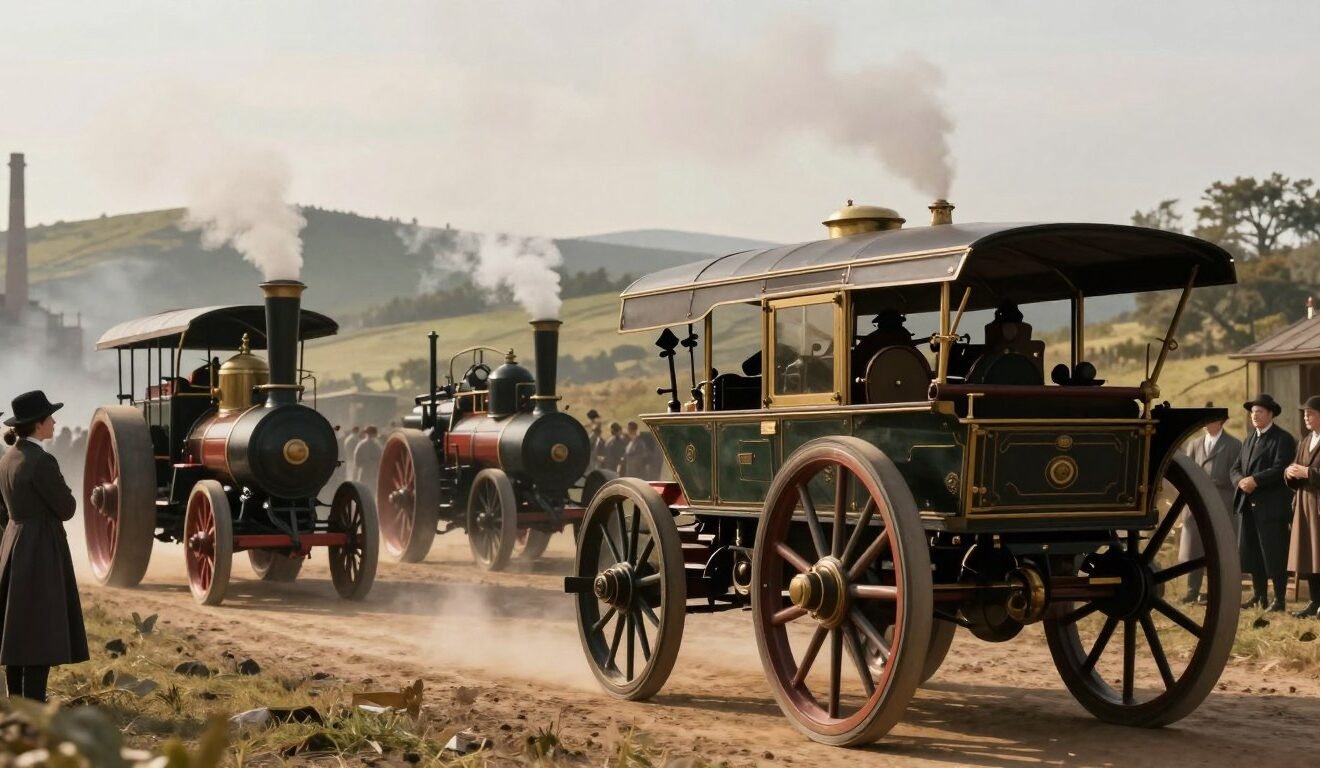
The arrival of steam-powered vehicles changed the game in transportation. As the Industrial Revolution grew, innovators like Richard Trevithick and Oliver Evans led the charge. They made steam power a key player in moving people and goods.
Richard Trevithick’s Road Locomotives
Richard Trevithick made big strides in steam power. His road locomotives could haul both people and goods, a major leap in self-moving vehicles.
The London Steam Carriage of 1803
The London Steam Carriage, built by Trevithick in 1803, was a game-changer. It showed steam power could work in cities.
Public Reaction and Technical Achievements
People had mixed feelings about Trevithick’s steam carriage. Some were amazed, while others worried about safety and noise. Yet, Trevithick’s work opened doors for more progress.
| Year | Innovation | Key Features |
|---|---|---|
| 1803 | London Steam Carriage | Steam-powered, carried passengers |
| 1808 | Circular Railway | Steam-powered locomotive, first steam railway |
Oliver Evans and American Steam Vehicle Development
Oliver Evans was a key figure in steam vehicle development in the U.S. His designs and skills helped shape America’s transportation future.
The Amphibious Orukter Amphibolos
Evans’ standout project was the Orukter Amphibolos. This steam-powered vehicle could move on land and water, showing steam power’s versatility.
Evans’ Vision for Steam-Powered America
Evans dreamed of a steam-powered America. His work set the stage for steam power’s widespread use in many industries.
Limitations and Challenges of Early Self-Propelled Vehicles
The first self-propelled vehicles hit many roadblocks. These were both technical and social. These hurdles made them less useful and harder to use.
Technical Constraints of Steam Power
Steam power was a big problem for early self-propelled vehicles.
Weight-to-Power Ratio Problems
The weight-to-power ratio was a big issue. These engines were heavy and big, which made them bad for moving.
Fuel Efficiency and Range Limitations
Early steam engines used a lot of fuel and couldn’t go far. They needed to stop often for more fuel and water. This made long trips hard.
Infrastructure and Social Barriers
Early self-propelled vehicles also faced big problems with roads and people.
Road Quality and Legal Restrictions
Roads were often bad, which made travel hard and damaged vehicles. There were also legal restrictions on using these vehicles.
Public Fear and Resistance
Many people were scared and didn’t want these vehicles. They thought they were too dangerous and changed things too much.
Safety Concerns and Reliability Issues
Safety and reliability were big problems too.
Boiler Explosions and Mechanical Failures
Boiler explosions and other failures were common. They were very dangerous for the people using them and those nearby.
Operational Complexity and Maintenance
These vehicles were hard to use and needed a lot of care. They needed skilled people to run them and were often broken and needed fixing.
In short, early self-propelled vehicles had many problems. These issues made it hard for them to get better and be used more. Fixing these problems was key to making transportation better.
From Steam Dreams to Modern Transportation
The start of the car era was a big change from steam to gas engines. This change was needed for better, more reliable, and smaller power sources.
The Transition to Internal Combustion
The move to gas engines was a key moment in car history. It fixed problems with steam power, like needing constant fuel and being too big.
Early Gas-Powered Engines
Nikolaus August Otto created the four-stroke cycle engine. This design is the base for today’s gas engines.
Key Innovators in Engine Evolution
Gottlieb Daimler and Wilhelm Maybach made the gas engine better for cars. They built the first car that ran on gasoline.
Direct Influences on Modern Automotive Design
The switch to gas engines changed car design forever. It affected steering, brakes, and how cars move.
Steering, Braking, and Transmission Legacies
Today’s cars have better steering, brakes, and gears thanks to early engineers. For example, hydraulic brakes made cars safer.
Manufacturing Techniques and Materials
Gas engines also led to better making cars. Henry Ford’s assembly line changed the car world.
As shown in the table below, engine tech has improved a lot with better making cars.
| Era | Engine Technology | Manufacturing Techniques |
|---|---|---|
| Early 20th Century | Internal Combustion Engines | Assembly Line Production |
| Late 20th Century | Fuel Injection Systems | Robotics and Automation |
| 21st Century | Hybrid and Electric Engines | Advanced Materials and 3D Printing |
“The modern automobile is a testament to the ingenuity of early innovators who dared to dream of a world without the constraints of animal power or the limitations of steam.”
Today’s cars still show the impact of early car innovations. This is seen in their design and how they’re made.
Conclusion: Legacy of the First Self-Propelled Vehicles
The first self-propelled vehicles have made a lasting impact on how we move around. From Ferdinand Verbiest’s steam-powered carriage to Nicolas-Joseph Cugnot’s steam wagon, these early designs were key. They showed us how to make travel faster and more efficient.
These early vehicles set the stage for today’s cars and trucks. Their journey from steam to internal combustion engines shows our drive for better ways to travel. Looking back, we see how these vehicles changed our world.
These early vehicles have inspired many in the field of engineering. Today, the car industry keeps growing, thanks to their legacy. Their story teaches us about the power of creativity and never giving up.